If you've spent any time in trading communities, you've heard some version of this: "Buyers are in control." "Sellers stepped in." "The bulls couldn't hold it." "Bears took over."
It's everywhere — in YouTube commentary, on trading forums, in post-market recaps. The language is so ubiquitous that you stop hearing it as a claim. It starts to feel like a description. Like it's just what markets are: buyers and sellers, pushing against each other, one side winning and one side losing.
Here's the problem. That frame answers the wrong question. And when you're trading, answering the wrong question with confidence is worse than having no answer at all.
The math that sounds like insight
Every single transaction in any market requires a buyer and a seller. One provides the bid, the other accepts it. Without both, there is no trade. This is not an insight about markets — it's the definition of a transaction.
So when someone says "buyers are in control right now," they're not telling you that buyers are doing something sellers aren't. Buyers and sellers are always present in equal measure, by necessity. The price you see on the chart is the record of a transaction — and transactions are always bilateral.
What the "buyers vs. sellers" frame is actually trying to describe is directional movement. Price went up, so buyers must have "won." Price went down, sellers must have "won." But that's a conclusion dressed up as an explanation. It describes the outcome and labels it as a cause. It doesn't tell you anything about the mechanism that produced it.
And the mechanism is what matters.
The question that actually matters
Two participants can both be buyers while doing completely different things in the market. That sentence is worth sitting with.
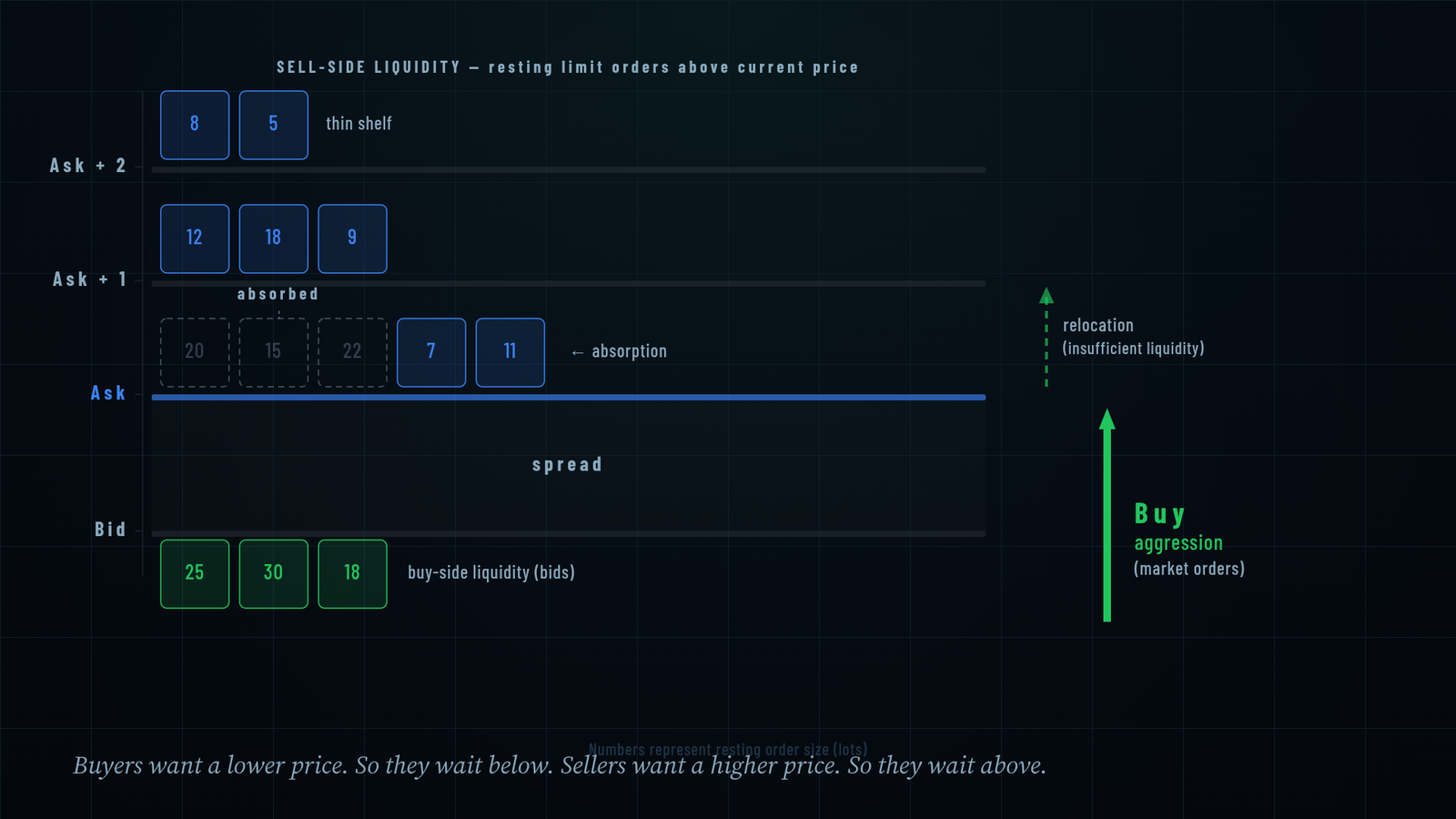
One buyer places a limit order at a specific price — they're saying, "I'll buy, but only at that price. I'll wait." That order sits in the market as resting liquidity. It doesn't move price. It provides a shelf that absorbs whatever comes at it.
The other buyer places a market order — they're saying, "I'll buy right now at whatever the market offers." That order demands immediate execution. It takes from whatever is resting at the current price. When enough of those arrive and the resting supply can't absorb them all, price moves.
Both are buyers. Their effect on price is completely different.
The distinction isn't who is active. It's how they're participating. And that distinction has a precise name: aggression versus liquidity.
Aggression is market orders demanding immediate execution. They move price by consuming the orders waiting at the current level. Liquidity is resting limit orders waiting to be filled. They absorb aggression. They don't cause movement — they slow it, halt it, or reverse it.
The direction price moves isn't determined by who "wins" between buyers and sellers. It's determined by whether arriving aggression — in whichever direction — has enough resting liquidity to absorb it. If it does, price stays. If it doesn't, price relocates to find it.
That's the mechanism. Not a contest between sides. A continuous interaction between orders that move and orders that wait.
What the wrong frame costs you
This might feel like a philosophical distinction — two ways of describing the same reality. It isn't. The frame you use shapes the questions you ask. And different questions produce different reads.
When you're watching a market move against you and you're thinking "sellers are in control," you're implicitly picturing a group of agents making decisions — a side that's organized, that has intent, that you need to predict. The logical next question is: "Will sellers keep selling?" And the answer to that question is: you don't know, because intent isn't visible on the chart.
When you're thinking in terms of aggression and liquidity, the question changes. "Is sell aggression being absorbed at this area, or is it overrunning available buy-side liquidity?" That question can actually be answered — not in advance, but in real time, as the interaction unfolds. You're watching the mechanism, not predicting the intent of a side.
One frame sends you hunting for something the chart can't show you. The other frame keeps your eyes on what the chart can show you: what's actually happening between resting orders and arriving aggression, right now, at this price.
The moment you start thinking about "who's in control," you've imported a question that has no mechanical answer. The chart records the interaction. It doesn't record the intent of the participants. — From the framework
What to say instead
I'm not asking you to speak in robotic sentences when you're thinking out loud. But I am asking you to notice when your language is carrying assumptions you haven't examined.
"Buyers are in control" assumes one side has something the other doesn't. It implies dominance, agency, decision-making. "Buy aggression is currently outpacing available sell-side liquidity" describes the observable condition: aggressive buy orders are arriving faster than the resting sell orders at the current price can absorb them. That's what "going up" actually is.
The second version is clunkier. It's also precise. And precision, when you're watching a live market with real money in it, is worth a great deal.
Here's a translation table — not to make you sound different, but to help you see differently:
| What you probably say | What's mechanically happening |
|---|---|
| Buyers are in control | Buy aggression is outpacing available sell-side liquidity |
| Sellers stepped in | Sell aggression arrived and is being absorbed — or overrunning — buy-side liquidity at this level |
| Bulls couldn't hold it | Buy-side liquidity at that area was consumed or withdrawn; sell aggression relocated price lower |
| Bears took over | Sell aggression began overrunning available buy-side liquidity at successively lower prices |
| The market is balanced | Aggression from both directions is being absorbed at roughly the same rate — neither side overrunning the other |
You don't need to say the long version out loud every time. But you need to know that's what the long version says — because that's what the chart is actually showing you. The short version is shorthand. The risk is when the shorthand starts substituting for the thought.
The "buyers vs. sellers" frame is so deeply embedded in how traders talk that it feels neutral — just vocabulary, not a claim. But vocabulary is never neutral. It shapes the questions you ask and the reads you make.
Every transaction has both a buyer and a seller. That's the arithmetic. The question worth asking is how each is participating — whether they're providing resting liquidity or arriving as aggression. That distinction is where the mechanism lives. And the mechanism is what the chart actually shows.
The book builds directly on this distinction — it shows you how to read the interaction between aggression and liquidity in real time, across multiple timeframes, and how to turn that read into a structured decision. That's the next step.