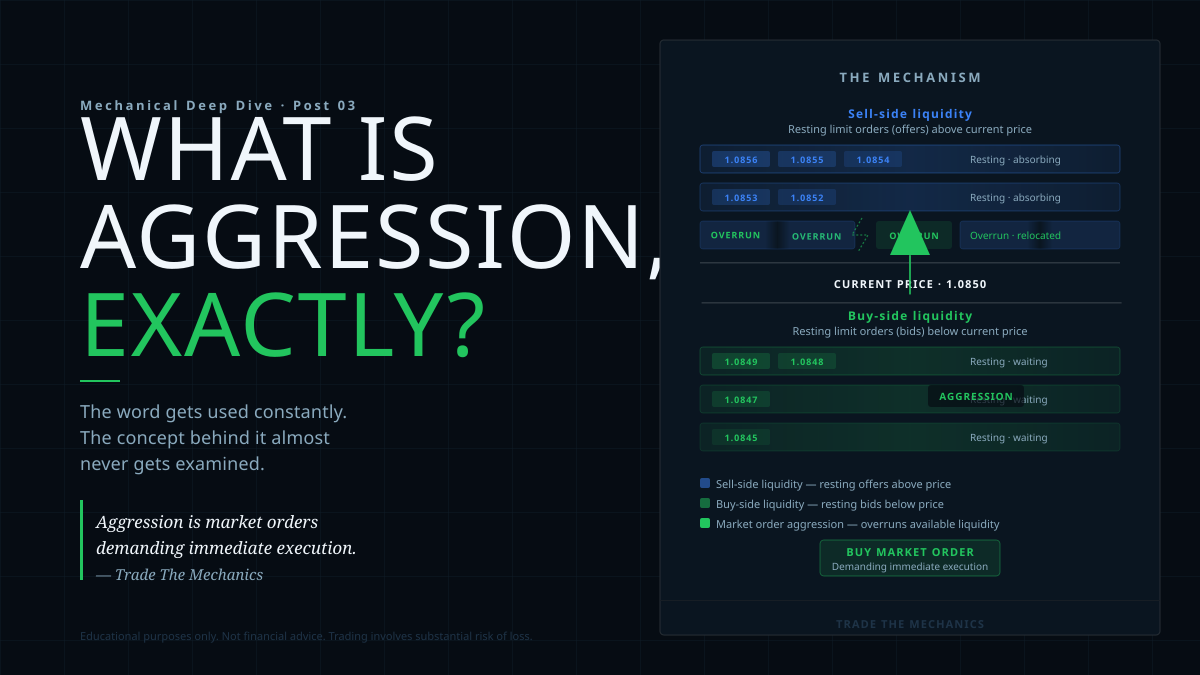
What Is Aggression, Exactly?
The word gets used constantly. The concept behind it almost never gets examined. That gap is costing you.
Most traders talk about the market as if two teams are playing tug-of-war. Bulls on one end, bears on the other. Whoever is stronger wins. Price moves in their direction.
That picture feels intuitive. It's also wrong — not slightly wrong, but wrong in a way that quietly poisons almost everything that follows from it.
The problem starts with a single unexamined word: participation.
Every transaction in the market has a buyer and a seller. That's not insight — that's arithmetic. You cannot buy without someone selling to you, and you cannot sell without someone buying from you. So if every move up had a buyer and a seller, and every move down had a buyer and a seller, then what exactly is the difference between a market going up and a market going down?
The difference is how the participants are participating. Specifically: whether they're being aggressive or providing liquidity.
The Two Ways to Be in a Trade
When you place a limit order — "I want to buy 10,000 units at 1.0850, and not a pip higher" — you are providing liquidity. You've stocked a shelf. Your order sits in the order book, waiting. It will be filled only if someone comes to you at your price. Until then, you are not moving anything. You are resting.
When you place a market order — "I want to buy 10,000 units right now, at whatever price is available" — you are the aggressor. You are taking what's on the shelves. You are demanding immediate execution. And because you're demanding it, you get it — at whatever the lowest available ask happens to be in that moment.
Aggression is market orders demanding immediate execution. That's the definition. Not enthusiasm. Not conviction. Not "smart money." Not the momentum of a move. Aggression is a specific type of order: one that says "fill me now, at whatever price."
Liquidity is the opposite — resting limit orders waiting at a specific price. They provide the shelves that aggression comes to take from.
This distinction matters more than almost anything else in the framework. Read that twice. Here's why.
Aggression Is the Force That Moves Price
Price sits where it is because there's resting liquidity on both sides — buy limit orders below current price, sell limit orders above. While those shelves are stocked, price doesn't go anywhere. Someone might be buying and someone might be selling, but they're finding each other at the current price. No movement.
Price moves when aggression runs out of liquidity at the current level. When buy market orders arrive faster than the available sell limit orders can absorb them, those buy orders start reaching up to the next available ask. Then the next. Price relocates upward. When sell aggression arrives and overwhelms available buy-side liquidity, price relocates downward.
Aggression is the force that relocates price. Liquidity is what it pushes against.
I know this sounds mechanical to the point of tedium. Bear with it, because here's the practical consequence: if aggression is the force that moves price, then what you are actually watching on the chart — candle by candle — is a record of aggression arriving and either being absorbed or overrunning what was there.
Not decisions. Not intent. Not teams competing. A mechanical interaction between orders demanding execution and orders waiting to be filled.
The question isn't "who has control?" The question is: is arriving aggression being absorbed at this price, or is it overrunning the available liquidity and relocating price to the next level?
Why "Buyers vs. Sellers" Gets This Wrong
When most traders say "buyers are in control," they mean price is going up. When they say "sellers are in control," they mean price is going down. The language implies that one side is winning a contest.
But both sides are always present. A limit order buyer and a market order seller are both "sellers" in the conventional sense — neither of them. Or both of them. The framing collapses the moment you try to be precise about it.
What's actually happening when price moves up is more specific: buy aggression is arriving and overrunning available sell-side liquidity. Sell limit orders aren't absorbing the incoming buy market orders fast enough — or at all. Price relocates up to the next level of sell-side liquidity.
What's happening when price stalls at a level is also specific: aggression is arriving, but the liquidity at that price is sufficient to absorb it. The shelves are stocked. The aggression gets filled, but price doesn't move.
The "buyers vs. sellers" frame gives you a vague sense of direction. The aggression/liquidity frame gives you something you can actually look at and evaluate on the chart.
The mechanical sentences are clunkier. That's the trade-off. They're also accurate — they describe what's happening in terms of the actual mechanism, not a sporting metaphor.
What This Changes About How You Read a Chart
Once you understand that aggression is the force that moves price, the chart starts telling a different story.
A candle moving strongly in one direction is a record of aggression arriving and consistently overrunning liquidity across that move. A candle with a long body means that aggression relocated price across that territory and — crucially — held it through the close. A long wick means aggression reached that price, but was absorbed and reversed before the candle closed.
When price sits at a level for several candles without breaking through, you're not watching indecision or balance. You're watching aggression arrive and get absorbed, repeatedly, at that price. The liquidity at that level is sufficient, at least for now. Whether it remains sufficient on the next visit is a separate question — one that depends on whether those limit orders are still there, which the chart alone can't tell you directly.
That's worth holding onto. The chart shows you the result of the interaction. It shows you whether aggression was absorbed or whether it relocated price. It does not show you the order book underneath — how deep the liquidity was, whether it's been refreshed, whether participants have withdrawn their orders. Those things reveal themselves only through what price does on each subsequent visit.
This is why the framework is built on observation, not prediction. You can observe whether incoming aggression is being absorbed right now. You cannot know in advance whether it will be on the next attempt. The chart gives you a read on the current state — not a guarantee about the next one.
Aggression is the engine underneath every candle on every chart you've ever looked at. Not sentiment, not conviction, not team dynamics. Market orders demanding immediate execution — arriving, being absorbed by liquidity or overrunning it, and producing price movement as the output.
Most trading education skips past this entirely and goes straight to patterns, setups, and signals. The mechanics underneath — what's actually happening when a candle forms, why price moves when it does — get treated as background noise. They're not background noise. They're the whole thing.
The book builds directly on this foundation — taking the aggression/liquidity framework and showing how to use it to read the current market state, identify when structure supports a thesis, and construct a mechanical approach to trading. That's where this goes once the foundation is solid.