Almost every trader has experienced this.
You wait patiently for a setup. You analyze the chart. You identify the direction. You finally enter the trade…
…and within minutes, price reverses directly against you.
Not a small hesitation. A sharp reversal. Almost as if the market saw your entry specifically and decided to move the other way.
After enough experiences like this, traders begin developing dangerous conclusions:
- “The market hunts my entries.”
- “My broker is trading against me.”
- “I always enter too early.”
- “Maybe I just have bad luck.”
But the reality is usually much less personal — and much more mechanical.
Price is not reacting to you.
What you are experiencing is usually the result of entering at the same location many other traders are also entering, often at the exact moment liquidity conditions are changing.
Once you understand the mechanics behind this behavior, the experience becomes far less emotional.
You stop feeling attacked by the chart.
And you start seeing why certain entries create vulnerability while others create stability.
The Retail Entry Problem
Most retail education teaches entries visually rather than mechanically.
Traders are taught to:
- buy breakouts
- buy support
- sell resistance
- enter after confirmation candles
- enter after patterns complete
At first glance, this sounds logical.
The problem is that these methods often cause large groups of traders to enter in extremely concentrated areas.
That concentration matters mechanically.
Because clustered entries usually produce clustered stops.
And clustered stops create predictable pockets of future aggression.
This is where the experience starts becoming confusing for traders.
They believe they entered at the “correct” location because the pattern looked valid.
But mechanically, they may have entered directly into:
- nearby opposing liquidity
- exhausted aggression
- thin continuation conditions
- a crowded participation area
The chart looked strong visually.
But structurally, the move may already have been vulnerable.
What Your Entry Actually Represents
Mechanically, your entry is simply an order entering the market.
If you use a market order, you are adding aggression.
If you use a limit order, you are adding liquidity.
Most retail entries happen using market orders.
That means your participation contributes to the existing directional pressure already occurring.
This matters because strong-looking moves often attract the highest amount of late participation.
As price expands upward:
- more breakout traders enter
- more confirmation traders enter
- more fearful traders chase
- more stops from short traders begin triggering
All of this creates increasing buy-side aggression.
But aggression alone does not guarantee continuation.
Continuation only happens if available opposing liquidity continues thinning or getting consumed efficiently.
Once that process slows down, the move can stall very quickly.
Why Reversals Often Happen Right After Entry
There are several common mechanical reasons this occurs.
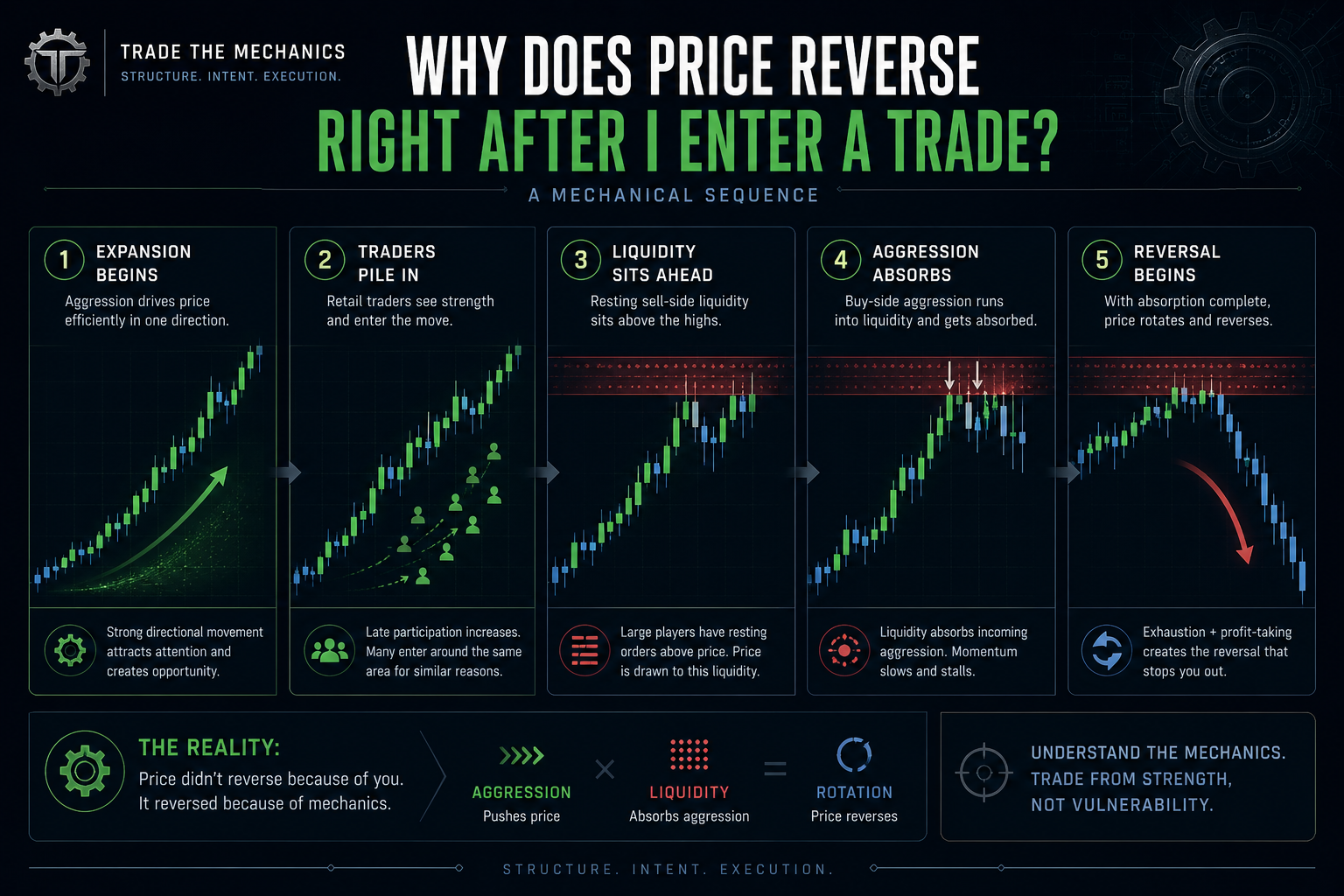
1. You Entered Into Liquidity
One of the most common reasons is simple:
You entered directly into resting opposing liquidity.
For example:
- price rallies aggressively upward
- retail traders see “strength”
- many traders enter long
- larger resting sell liquidity sits slightly above
The upward aggression reaches that liquidity and begins getting absorbed.
The result is often:
- slowing candles
- long upper wicks
- failed continuation
- rotation back downward
To the retail trader, it feels like:
“I entered and the market instantly reversed.”
Mechanically, the move simply ran into liquidity.
2. You Entered After the Expansion Already Happened
Another common issue is late participation.
Strong expansions attract attention.
The problem is that by the time the move becomes emotionally obvious, much of the efficient relocation may already have occurred.
This creates a dangerous situation:
- early participants are already in profit
- late participants are just entering
- the move becomes crowded
- continuation now requires even more aggression
At some point, the incoming aggression is no longer sufficient to continue relocating price efficiently.
The move slows.
Profit-taking begins.
Liquidity thickens.
Price rotates.
The reversal is not punishment for entering.
It is often exhaustion appearing after the most visually attractive part of the move.
3. Your Entry Location Was Structurally Weak
Many traders focus heavily on “signals” while barely evaluating location.
But location changes everything.
A strong-looking bullish candle inside balanced conditions is very different from:
- a bullish candle after acceptance higher
- a bullish candle after liquidity withdrawal
- a bullish candle after failed downside continuation
The candle itself may look identical.
But the surrounding structure completely changes the quality of the participation.
This is why pattern memorization alone creates inconsistent results.
Patterns do not explain context.
They only describe appearance.
The “Magnet” Feeling Traders Experience
Many traders describe a strange sensation:
“It feels like price is attracted to my stop the moment I enter.”
That feeling usually comes from clustered positioning.
Retail traders often learn similar entry models:
- enter above breakout
- place stop below recent low
- target continuation
When many traders do this simultaneously:
- entries cluster
- stops cluster
- future liquidity becomes concentrated
Price does not “want” those stops.
But mechanically, those clustered stops represent future market orders waiting to trigger.
That makes the area mechanically important.
Once price begins moving toward those stops:
- stops trigger
- aggression increases
- temporary relocation accelerates
This often creates the exact experience traders interpret emotionally as:
“The market came specifically for me.”
In reality, you were simply positioned where many others were positioned too.
Why Entry Timing Matters Less Than Traders Think
Retail education often becomes obsessed with “perfect entries.”
But mechanically, entries matter less than overall thesis quality.
A slightly imperfect entry inside strong structural conditions is often far safer than a precise entry inside weak conditions.
This is an important shift.
Because many traders spend years searching for:
- better indicators
- more confirmation
- better candlestick patterns
- lower timeframe precision
While barely improving:
- context reading
- state identification
- liquidity interpretation
- continuation quality assessment
The result is traders becoming increasingly precise inside increasingly weak ideas.
What Strong Entries Usually Have in Common
Strong entries are rarely defined by perfection.
Instead, they tend to share several mechanical characteristics:
- participation aligns with broader structural conditions
- liquidity conditions support continuation
- the trade is not entering directly into obvious opposing liquidity
- the move is not already overcrowded
- invalidation is structurally clear
Notice what is missing from that list:
- patterns
- indicator signals
- candle names
Those things can sometimes help organize observations.
But they are not the actual mechanical drivers.
The Shift That Changes Everything
Most struggling traders ask:
“How do I stop price from reversing after I enter?”
But that question assumes reversals are abnormal.
They are not.
Markets rotate constantly.
Continuation is never guaranteed.
The better question becomes:
“What conditions make continuation mechanically more likely?”
That shift changes the entire mindset of chart reading.
Instead of searching for certainty, you begin evaluating:
- participation quality
- structural alignment
- aggression efficiency
- liquidity conditions
- invalidation clarity
This produces calmer decision-making because you stop expecting the market to obey your entry.
You start understanding that every trade is simply participation inside evolving conditions.
Final Thoughts
Price does not reverse after your entry because the market is targeting you personally.
Most of the time, the reversal happens because:
- your entry location was crowded
- the move was already extended
- liquidity conditions changed
- continuation weakened
- you entered directly into opposing liquidity
Once you understand the mechanics behind these behaviors, the emotional experience changes dramatically.
You stop treating reversals as betrayal.
You stop searching for magical precision.
And you begin focusing on something much more useful:
learning how participation, liquidity, and structure interact to produce movement in the first place.
That is where real chart reading begins.