Why Do My Stop Losses Keep Getting Hit Right Before Price Reverses?
Every trader has lived this one. You place a trade. You set your stop below the swing low, just like you were taught. Price drifts down, tags your stop, you're out. And then — sometimes within seconds — price reverses and goes exactly where you thought it was going.
It feels personal. It feels like the market waited for you specifically. And after it happens enough times, you start wondering whether someone out there is watching your account, waiting for your stop before they let price move.
Nobody is. What's actually happening is mechanical, predictable, and completely explainable once you understand what a stop loss actually is.
A Stop Loss Is Not What You Think It Is
Most traders think of a stop loss as a barrier — something that stands between their account and a runaway loss. A line in the sand. Protection.
That's not what it is.
Mechanically, a stop loss is a conditional market order. It sits dormant in the system until price reaches the level you specified. The moment it does, the stop wakes up and converts into a plain market order — a demand for immediate execution at whatever price is currently available. No conditions, no preferred price, no negotiation. Just fill me now.
That's the critical detail. When your stop triggers, it is no longer a stop. It is aggression. If you were long, it becomes a market sell order — hitting the bid, taking whatever is there. If you were short, it becomes a market buy. The stop didn't protect you passively. It fired into the market and did something.
And here's the thing: you are not the only one whose stop just fired.
Why Stops Cluster at Obvious Levels
Think about where most traders put their stops. Below the recent swing low for long trades. Above the recent swing high for short trades. Just outside the range. At round numbers. Below the "key support."
These aren't random choices. They came from courses, books, YouTube videos, forums. Thousands of traders learned the same rules from the same sources, looked at the same chart, and placed their stops in the same area.
Nobody coordinated this. Nobody had to. The logic is identical, so the output is identical. Prior swing lows and round numbers don't attract a few stops — they attract enormous clusters of them, stacked in a narrow band of prices, all waiting for the same trigger condition to be met.
Your stop has a lot of company at the obvious level. That company has consequences.
The Mechanical Cascade
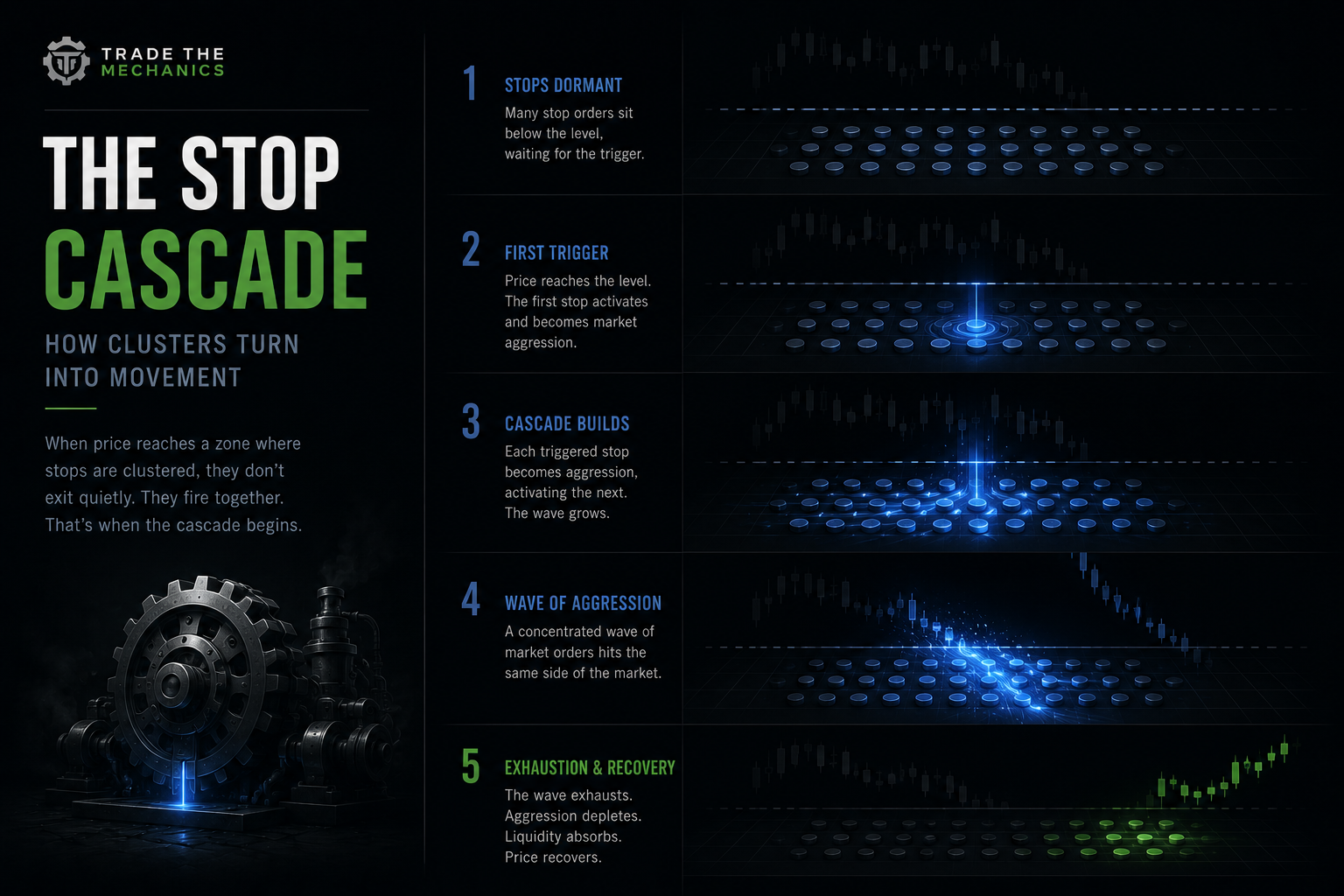
Here's what happens when price reaches a level where stops are clustered.
The first stop triggers. It becomes a market order and fires into the market. That small movement takes price slightly further into the cluster, which triggers the next stop, which fires, which pushes price a little further, which triggers the next one. The cascade builds quickly. What started as a few orders becomes a wave — a concentrated flood of aggressive market orders all hitting the same side of the market at the same time.
That wave needs to be absorbed by the opposing liquidity sitting on the other side. Whether it gets absorbed depends entirely on how much is there.
If there's deep liquidity to meet the wave, the aggression gets absorbed cleanly and price barely moves beyond the level. If liquidity is thin — if there aren't enough resting orders on the other side to soak up the volume — the wave pushes price significantly further than the trigger level. Sometimes well further. And then, once the wave has exhausted itself and aggression is temporarily depleted, price recovers.
That recovery is what you're watching when you see price reverse right after your stop hits. It isn't reversal from support. It's the aftermath of a mechanical cascade burning out. The wave ran out of energy. Price normalized.
Your stop didn't get hit because someone targeted you. It got hit because it was sitting in a crowd, and the crowd made noise.
The Slippage Problem Nobody Mentions
There's a second consequence that's worth understanding: your stop guarantees a trigger, not a price.
When your stop activates and joins a wave of other stops doing the same thing simultaneously, all of those orders are competing for fills at the same moment. The first orders in the wave fill against whatever liquidity is available at the trigger price. But if the wave is large enough, that liquidity gets consumed and the remaining orders move to the next available price, then the next, each one worse than the one before.
This is slippage. It isn't your broker stealing from you. It's the mechanical result of what market orders are and what happens when many of them arrive at once. You set the stop at a specific level. You might exit meaningfully below it if the wave is large enough and liquidity is thin enough.
The more crowded your stop, the worse the potential slippage. The most logical stop placement — the one every course teaches — is often the most crowded and therefore the one with the worst fill risk.
How to Place Stops Where This Is Less Likely to Happen
The answer isn't to abandon structure. Structural logic still matters — you need a reason for where your stop sits, and that reason should be mechanical, not arbitrary. A fixed pip count below entry doesn't tell you anything about the market. It tells you how much money you're willing to lose, which is a completely different question.
The shift is this: think about what your stop placement actually means mechanically, and then account for the geometry of the crowd.
If the structural level that would invalidate your trade sits at a prior swing low, your stop belongs somewhere in that region — but not exactly at the obvious tick. The obvious tick is where the wave begins. The fill you get when you're in a crowd is somewhere further along the wave, where the cascade has pushed price before exhausting. Placing your stop slightly beyond the obvious level — far enough to clear where the densest cluster is likely to be — gives you a better chance of either not triggering at all during the wave, or triggering with a fill that reflects where the wave actually ends rather than where it starts.
This isn't about widening your stop randomly. It's about understanding that the obvious level is the beginning of the mechanical event, not the end of it, and positioning accordingly.
Position size is the lever you use to keep risk honest when the stop is slightly further out. A smaller position with a structurally honest stop is cleaner than a larger position with an arbitrary stop placed at a level your analysis didn't actually define.
It's Geometry, Not Malice
The feeling that the market is targeting you is understandable. The timing is precise enough that it looks intentional. But intention requires an actor, and the market doesn't have one.
What the market has is geometry. Obvious levels attract orders. Orders cluster. Clustered stops release concentrated aggression when they trigger. That aggression either gets absorbed or it relocates price. The outcome is determined by the balance of orders present at that moment — not by anyone's interest in your specific position.
Understanding this doesn't make the sting go away immediately. But it does change what you do about it. If it's geometry, it can be planned around. If it's malice, you're helpless. The mechanical explanation is actually the empowering one — because it gives you something to work with.
Stop losses are not barriers. They're dormant market orders waiting to become aggression. Where you place them, and how you account for the crowd that's likely to be there with you, is part of reading the market mechanically rather than just drawing lines and hoping.