The first question is simpler and more honest: what is the market doing right now?
Not what will it do next. Not what has it been doing for the past month. What is it doing in the stretch of chart currently in front of you? Right now, in this behavior, what is happening between the buyers and sellers?
There are three possible answers. Every stretch of market behavior fits one of them — or is too mixed to read clearly, which is also a useful answer.
Expansion
Expansion is what one-sided control looks like.
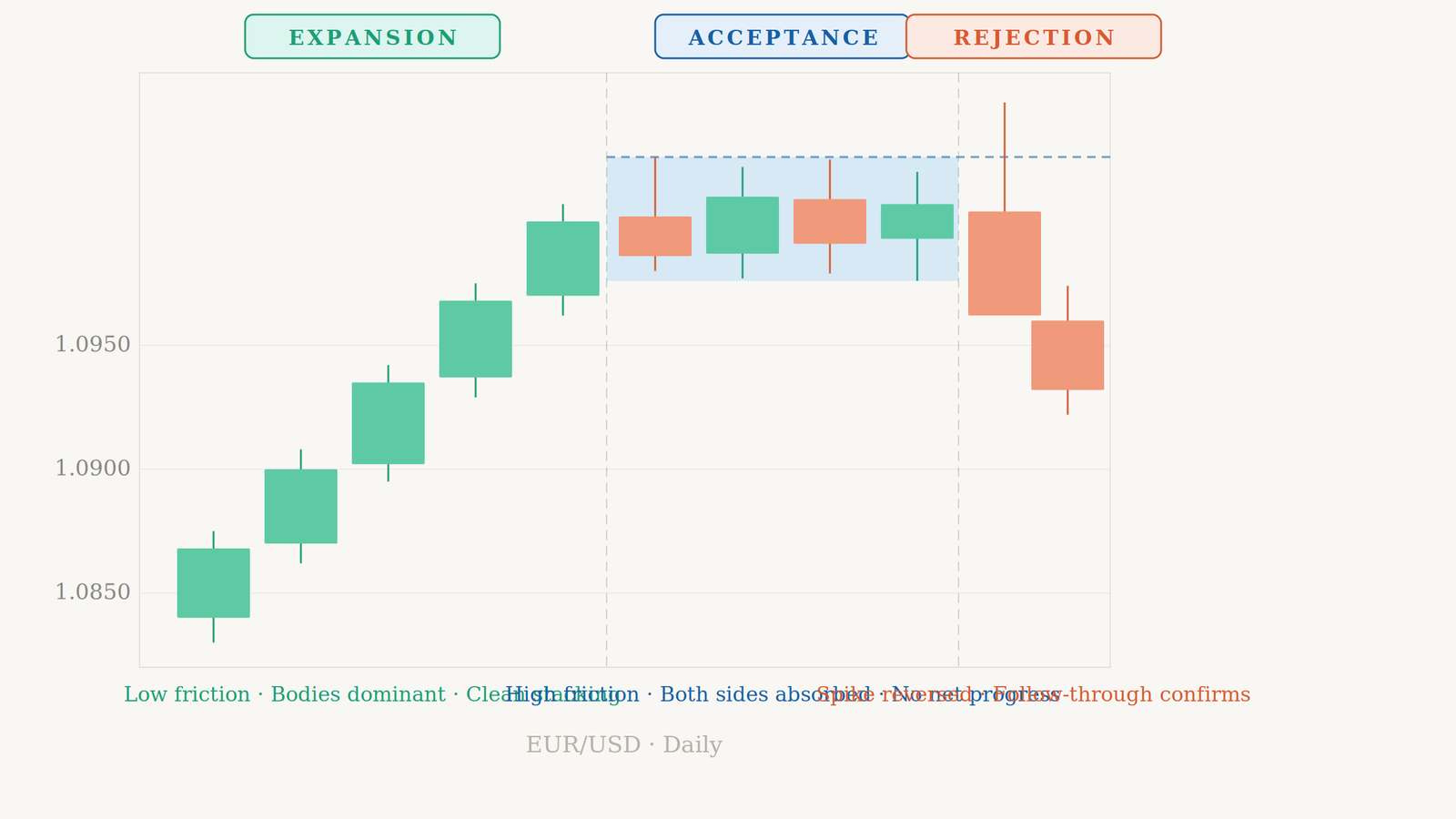
The candles are stacking cleanly in one direction. Bodies are large relative to wicks — meaning aggression is claiming territory and holding it through the close, not just pushing and getting reversed. There's low friction between adjacent candles, meaning each one is opening near where the last one closed and pushing further, rather than retreading the same ground repeatedly.
When you zoom out slightly, the counter-moves within the expansion are shallow. The opposing side is arriving — it always is — but it's not absorbing at scale. Whatever liquidity is sitting in the path of the dominant side isn't enough to contain what's coming at it.
Expansion describes a market where one side is currently winning, repeatedly, across multiple interactions. Not historically. Not on average. Right now, in this specific stretch of candles.
The most important thing I can say about expansion is also the thing most traders get wrong about it: expansion describes the present. It makes no statement about how long it will last or what happens when it ends. A market in expansion can transition into acceptance or reverse at any time. The behavior in front of you tells you what is happening. It does not tell you what comes next.
Acceptance
Acceptance is what balance looks like.
Both sides are active and neither is winning. The friction is high — candles overlap, closes alternate direction, wicks reach into both sides. Aggression is arriving from both directions and being absorbed by whichever liquidity is at that price. The result is a lot of movement that doesn't go anywhere meaningful.
Acceptance is the market finding a price range where both sides are comfortable transacting. It isn't bullish or bearish. It isn't deciding. It's genuinely balanced in the current moment, with neither side building enough sustained dominance to push price into new territory.
There's a mistake that's very easy to make in acceptance, and it's worth naming directly. Because acceptance often follows a directional move, traders frequently assume it's a pause before continuation in the same direction. Sometimes it is. Sometimes it's a pause before reversal. Acceptance itself carries no information about which one comes next — it has no memory of what preceded it. The prior direction creates no bias for what follows the acceptance. You don't know which way the balance will break until the break actually happens and follow-through confirms it.
Rejection
Rejection is what happens when price moves into an area and gets pushed away with conviction.
This one has a specific requirement that a lot of traders skip, and skipping it is expensive. Rejection is not a single dramatic wick. A long wick on one candle tells you that aggression pushed price to some level and was reversed before the close. That's useful information. But a wick alone is not rejection.
Rejection requires follow-through. Price has to continue moving away from the area across subsequent candles. The opposing side doesn't just win one candle — it wins the next one, and the one after that. The initial reversal holds, builds, and demonstrates that the move away from that location is genuine rather than temporary.
Without that follow-through, you have a wick. With it, you have rejection. The difference is whether what you're observing is a single moment of absorption or a sustained statement that the market doesn't want to be at that price.
Why These Are Descriptions, Not Setups
I want to be precise about what these three labels are, because the way most trading education works will push you to treat everything as a setup to trade.
Expansion, acceptance, and rejection are observations. They describe what is happening mechanically in a stretch of candles. They are not signals. They are not triggers. Seeing expansion doesn't mean you enter long. Seeing rejection doesn't mean you fade the move. The label tells you what the market is doing — what you do with that information is a separate question that requires more context than a single behavioral description can provide.
The right first step is just to read accurately. Before you think about direction, before you think about entries, before you think about anything else — look at the stretch of candles in front of you and ask: what is this describing? Is one side dominant and consistent? Are both sides active with no clear winner? Is price being pushed away from a location with conviction and follow-through?
If the answer isn't clearly one of those three, that's also useful information. It means the market isn't giving you something clean to work with. And sometimes the most disciplined thing you can do is wait until it does.