There's a problem with that approach, and it's not that the patterns are useless. Some of them show up reliably enough to be worth knowing. The problem is that pattern recognition gives you the shape without explaining what produced it — and without that understanding, you're essentially memorizing vocabulary without knowing the language.
A candle is a record of what happened during a specific period of time. Not a signal. Not a prediction. A record. And once you understand what it's recording, you start seeing information in candles that pattern names completely fail to capture.
What the Body Is Actually Recording
The body of a candle is the distance between the open and the close. That's it, mechanically. It tells you where price started that period and where it ended up.
But think about what that means in terms of what actually happened. If the close is higher than the open — a bullish candle — buy aggression consistently overran available sell-side liquidity enough during that period for price to end up at a higher level than where it started. That's not just "buyers were in control." It's a description of a mechanical imbalance: more demand for immediate upward execution than there were resting sell orders available to absorb it.
A large body in one direction means that imbalance was significant. The side in control wasn't just slightly ahead — it was consistently overrunning the opposition across the entire period, open to close, without enough counter-aggression to meaningfully drag price back.
A small body means the imbalance was limited, or that both sides were active enough that despite whatever directional movement happened during the period, they ended up nearly where they started. Something was absorbing the aggression.
The body tells you the net result.
What the Wicks Are Actually Recording
The wicks — the lines extending above and below the body — are what most traders either ignore or use as vague indicators of rejection. But they're recording something specific.
An upper wick means price relocated upward during that period, reached some level, and was pulled back before the close. Buy aggression tried to push price higher, and it succeeded temporarily — but then sell-side liquidity absorbed enough of it to drag the close back down, away from the high.
A lower wick means the opposite: sell aggression pushed price down, but buy-side liquidity absorbed enough of it to bring the close back up from the low.
The wick is a record of attempted relocation that didn't hold. Price went there and came back.
This is why a candle with a long upper wick and a tiny body tells a different story than a candle with a large bullish body. The first says: buyers tried hard, got somewhere, and were pushed back. The second says: buyers consistently dominated, open to close, with minimal counter-pressure. Both might be called "bullish" in casual conversation. Mechanically, they're describing completely different situations.
The Caveat You Actually Need to Know
Here's what a candle cannot tell you: the sequence of what happened during the period.
A candle shows you open, high, low, close. It does not show you the order. Whether the wick formed at the beginning of the period and price spent the rest of it recovering, or whether price moved steadily in one direction and then got slammed in the last few minutes — you can't see that in the candle itself.
This isn't an abstract limitation. It matters for reading individual candles in isolation. A doji — where open and close are roughly equal — could mean the market oscillated back and forth all period with neither side gaining ground. Or it could mean price moved aggressively in one direction, then aggressively reversed to end up where it started. Those are different situations with different implications, and the candle looks identical in both cases.
This is part of why reading a single candle in isolation is almost never enough. One candle is a data point. The context around it — what the preceding candles show, how friction has been behaving, what state the market is in — is what converts a data point into useful information.
Friction: The Read No One Taught You
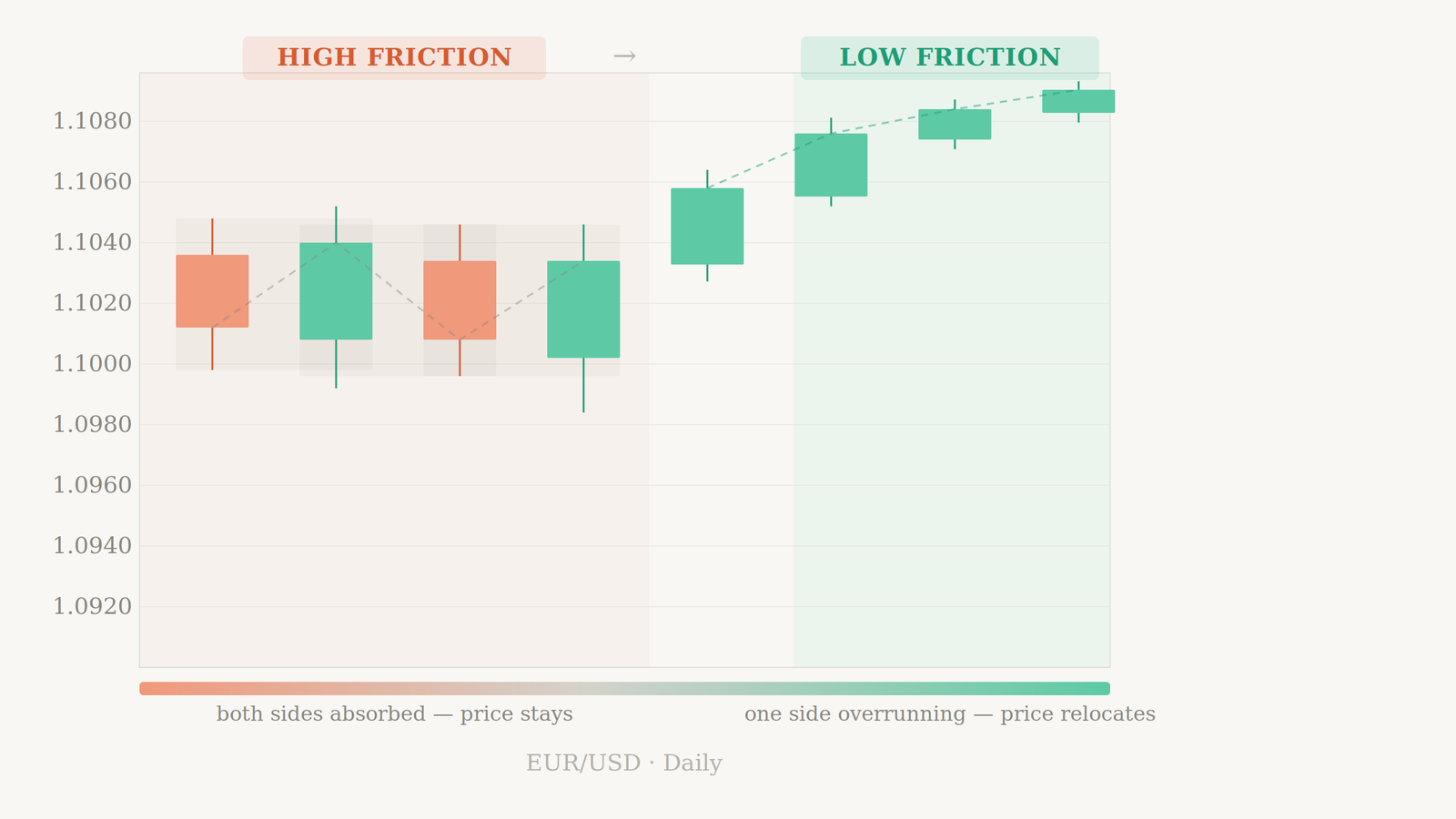
The most important thing to read on a chart isn't individual candle shapes. It's how candles relate to each other — specifically, how much they overlap in price range.
Picture two candles side by side. If the second candle trades across the same price territory the first one already covered — if it opens inside the first candle's range, revisits the same prices, and makes little net progress — that's friction. High friction. The market is retreading ground.
Now picture a sequence where each candle opens near where the previous one closed and pushes clearly into new territory. No retreading. Each candle picking up where the last one left off. That's low friction. Clean directional progress.
High friction is what you see when both sides are active and roughly matched. Aggressive buyers are arriving, but sell-side liquidity is absorbing them before they can push very far. Then sell aggression arrives and gets absorbed in the other direction. The candles keep revisiting each other's territory because neither side can overrun the other long enough to get clear.
Low friction tells the opposite story. One side is consistently outrunning the other. Each wave of aggression relocates price a bit further, and by the time the next wave arrives, price hasn't been pulled back. Candles stack. Bodies dominate. Progress is clean.
The Direction of Change Is What Matters Most
Here's something that most traders miss about friction: what matters isn't just the current level — it's whether it's changing.
A chart that's been in low friction for twenty candles is one thing. A chart that was in low friction and is now showing increasing overlap — bodies shrinking, wicks growing, counter-candles appearing — is telling you something different, even if the absolute friction level is still relatively low. The dominant side's control is degrading. The move may continue, but the conditions supporting it are changing.
Decreasing friction is the opposite signal. A market that was choppy and overlapping and is now starting to stack cleanly is a market where balance is breaking. One side is starting to overrun the other. That transition — not when low friction is fully established, but when it's just beginning to emerge — is often where the clearest reads happen.
Think of friction as a dial rather than a switch. It's not simply "high" or "low" as two binary states. It's a continuous scale that's always moving in some direction, and your job is to notice that direction and what it's telling you about the current balance between aggression and liquidity.
Putting It Together
A candle isn't a signal. It's a record of one period of interaction between aggression and liquidity — the net result in the body, the attempted-and-reversed movements in the wicks.
A sequence of candles, read for friction, tells you something the individual candles can't: whether one side is dominant right now, whether balance is shifting, whether the market is going somewhere or just making noise.
The shapes you learned to recognize — the hammers, engulfings, dojis — they're real patterns, and they show up on charts because real mechanical things produce them. But knowing the name of the shape is not the same as understanding what produced it.
Once you start reading candles for what they're actually recording, a lot of chart behavior that used to feel random starts to make mechanical sense. Not because you've found a better pattern. Because you understand what the chart is actually showing you.
That shift — from pattern recognition to mechanical observation — is the whole difference.